
America the Damnable
The Day of Judgment is Here and Your Pastor May be in Trouble


The Judgment Is Already Happening
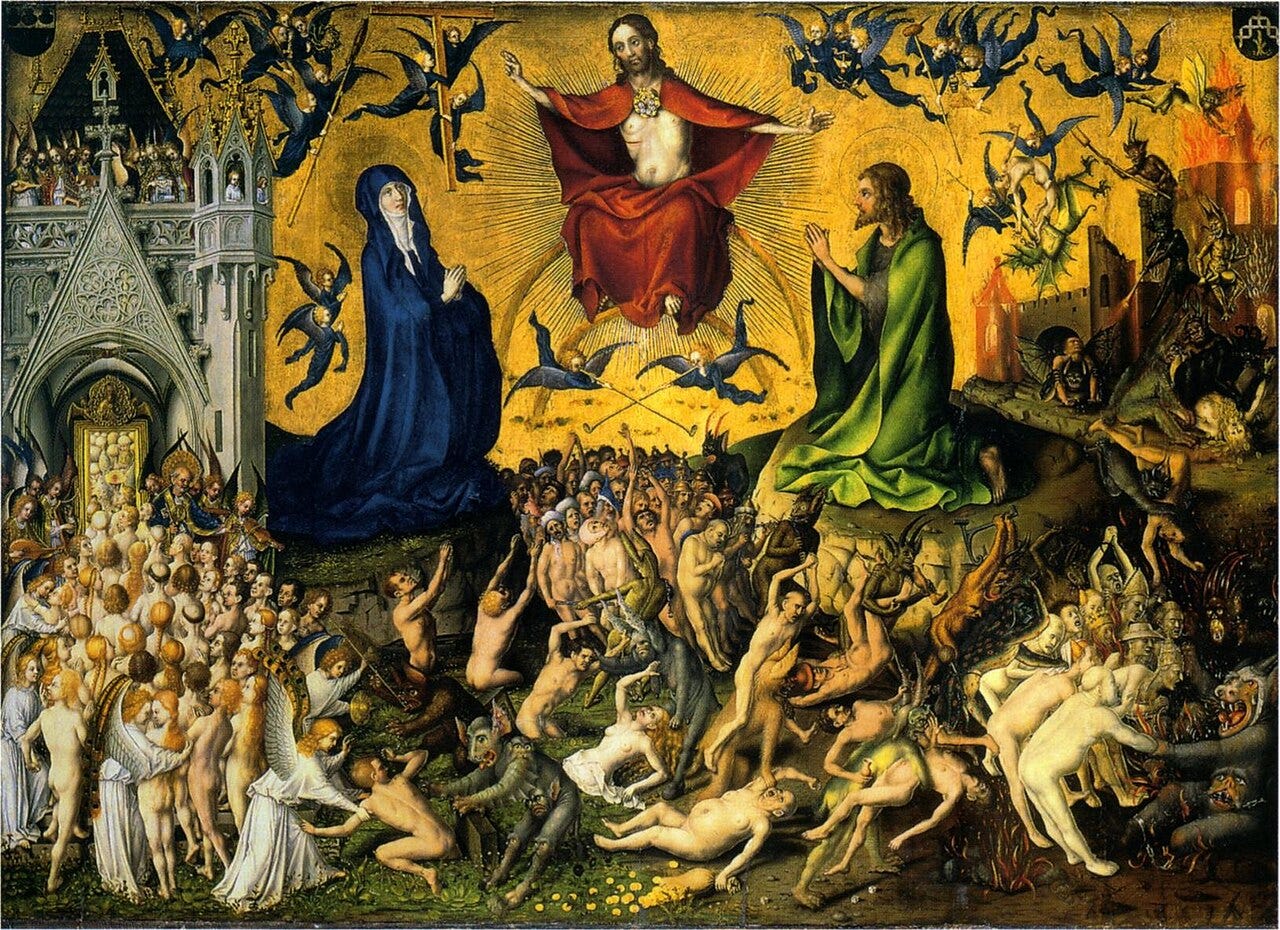
David Bentley Hart recently recorded a sermon for the Orthodox Christian Studies Center at Fordham University’s “Orthodox Scholars Preach” series. His slot in the liturgical cycle fell on the Sunday of the Last Judgment. He titled it “A Sermon on Judgment, by Someone with No Pastoral Gifts.” That title is not mere self-deprecation. This is not a sermon designed to comfort, but it is a prophetic warning for many in our country and around the world. You can find it posted to his Substack, and if you subscribe, it’s worth your time.

The text is Matthew 251, the scene where the Son of Man gathers the nations before his throne and separates them the way a shepherd separates sheep from goats. Famously a universalist who rejects eternal conscious torment, there might be some who find it odd at first for Hart to be reflecting on and warning about the Day of Judgement. Here it is helpful to note that while most English Bibles render the final verse as “eternal punishment.” Hart’s translation of the New Testament gives you something different:
“These will go to the chastening of that Age, but the just to the life of that Age.”
The word underneath “chastening” is kolasis, which Hart’s footnote traces back to its classical meaning of pruning, correction, or being held in check. Aristotle distinguished it from timōria, which is purely retributive. It’s worth sitting with that for a moment, because it is easy to hear “chastening” and think Hart is softening the stakes. He isn’t. Rejecting eternal conscious torment is not the same as rejecting hell fire. It is a claim about what the fire is for. And what awaits those who fail this judgment, in Hart’s own accounting, is still terrible to contemplate.
What strikes him of particular importance for this sermon in Matthew 25 is what the criteria of judgment actually are. Not baptism. Not doctrinal adherence, church membership, personal belief, or correct theology. What determines how the nations stand before the throne is whether they fed the hungry, clothed the naked, welcomed the stranger, visited the prisoner. Entirely moral. Entirely practical. Which is why Hart can say, and does say, that it is “an obscenity that there are those in this nation who call themselves Christians and yet have allied themselves to this satanic regime. How this can be, it seems pointless to speculate, but how the story of those who profane their faith by such an alliance will end, as far as we can tell from the great allegory of judgment in Matthew, is terrible to contemplate.”
But the more striking move is about when judgment happens. Hart argues the great pronouncement of judgement in Matthew 25 is not a future verdict being handed down. It is a past verdict being disclosed:
“The verdict that determines how we stand in the light of eternity is simply a fait accompli, because it is not so much a judgment Christ passes upon us as it is a revelation of the judgment we passed upon Christ in the course of our lives. The final judgment is now because we are always already standing before the dread judgment seat, which is to say before the face of God unveiled in Christ.”
The Son of Man doesn’t decide anything at the end. He reveals what we already decided, across the whole of our lives, every time we encountered suffering and chose how to respond. The Gospel of John makes the same point without the allegory. “Now is the judgment of this world,” Jesus says. Not eventually. Now. Hart reflects on this:
“Now is the judgment of the world. So now Christ meets us in the face of the migrant, or for that matter, the citizen with brown skin, viciously beaten or imprisoned by agents of a merciless regime. Christ confronts us as our judge in the face of a five-year-old child in a bunny hat, kidnapped and imprisoned. Christ demands that we give an account of ourselves when we see him, Christ, beaten down again by the agents of empire, though now he is wearing the form of a VA nurse to be murdered once more by the state. We have today to choose for ourselves life or death. Christ is crucified daily in our midst.”
If Christ meets us in the face of the suffering, the imprisoned, the refugee, and the migrant, then our response to those people is not a social concern running alongside our faith. It is the site of judgment itself, already underway.
And Matthew 25 is not addressed to individuals alone. The Son of Man gathers the nations, it says. The verdict falls on communities, polities, peoples with continuous histories. Which means collective political life is subject to the same criteria as individual moral life. How a nation treats the least of these is not a separate question from how it stands before God. It is the same question.
Hart says plainly that our nation, by those criteria, is a damnable one. He says it is “a lie and therefore a complicity with evil to separate the annunciation of the gospel before the altar from the actual moral and political realities of the moment.” He calls the regime satanic. Not as a provocation, but as a theological description of what it is doing and to whom.
What makes this moment particularly worth sitting with is that the people most loudly claiming the banner of Christ right now are the ones presiding over this. They will tell you they are defending Christianity. They are focused on rooting out sexual sin, on securing borders, on restoring Christian civilization through political force. None of those are the criteria. Not one of them appears in Matthew 25. The criteria are the hungry, the thirsty, the stranger, the naked, the sick, and the prisoner. Those people are being abducted, caged, and terrorized right now, and they are being abducted, caged, and terrorized by people who go to church on Sunday.
What they are defending is not Christ. It is a Christ of their own construction, one whose priorities happen to align perfectly with their political program. And while they defend that Christ, they are damning the real one. Every detained child, every deported mother, every asylum seeker processed through a system designed to brutalize, is Christ meeting them at the moment of judgment. They are failing that encounter under a banner that proclaims the virtues of that failure.
As Hart puts it, “nowhere does God elect a race or consecrate borders.” His children are all one in him. The project of building Christendom through legislative force and immigration enforcement presupposes a Christ who can be installed in power, whose kingdom can be secured through coercion. That is not the Christ of Matthew 25. The Christ of Matthew 25 is wearing a prison uniform, hidden away in Alligator Alcatraz.
The sermon ends with an image invoking the old patristic trope, the Eucharist as the burning coal the seraph pressed to Isaiah’s lips. Whether it burns or purifies, Hart says, “lies in our hands and in our hearts and in the power of our eyes to discern how the Lord of glory shows himself to us in those who require our love and our mercy.”
Matthew 25:31-46, 31 And when the Son of Man comes in his glory, and all the angels with him, then he will sit on his throne of glory; 32 And all the nations will be assembled before him, and he will separate them from one another, as the shepherd separates the sheep from the kid goats, 33 And will set the sheep to his right, but the kid goats to the left. 34 Then the King will say to those to his right, ‘Come, you blessed by my Father, inherit the Kingdom prepared for you from the foundation of the cosmos. 35 For I was hungry and you gave me something to eat, I was thirsty and you gave me drink, I was a stranger and you gave me hospitality, 36 Naked and you clothed me, I was ill and you looked after me, I was in prison and you came to me.’ 37 Then the just will answer him, saying, ‘When did we see you hungry and feed you, or thirsty and give you drink? 38 And when did we see you a stranger and give you hospitality, or naked and clothe you? 39 And when did we see you ill or in prison and come to you?’ 40 And in reply the King will say to them, ‘Amen, I tell you, inasmuch as you did it to one of the least of these my brothers, you did it to me.’ 41 Then he will say to those to the left, ‘Go from me, you execrable ones, into the fire of the Age prepared for the Slanderer and his angels. 42 For I was hungry and you did not give me anything to eat, I was thirsty and you did not give me drink, 43 I was a stranger and you did not give me hospitality, naked and you did not clothe me, ill and in prison and you did not look after me.’ 44 Then they too will answer, saying, ‘Lord, when did we see you hungry or thirsty or a stranger or naked or ill or in prison, and did not attend to you?’ 45 Then he will answer them, saying, ‘Amen, I tell you, inasmuch as you did not do it to one of the least of these my brothers, neither did you do it to me.’ 46 And these will go to the chastening of that Age, but the just to the life of that Age.”
Hart, David Bentley. The New Testament: A Translation (pp. 52-53). (Function). Kindle Edition.
Those flying the “Christ” banner in the name of dominant political power would invoke an “apocalyptic Messiah”, warring against all those they demonize. They don’t realize he may be coming to confront the “demonizers”. They don’t imagine for a moment that The Christ may return to correct and prune those that used the “god-image” to trample Image bearers — the ones that (when cared for) birth a true religion in the hearts of men.
I literally just wrote about this in my last article regarding undocumented people’s connection with God and how it opposes Christian Nationalism’s theology. I think you and your followers might like it!