
We Will All Be Trans-figured
Trans and Non-Binary Lives as a Foretaste of the Resurrection

Thanks for reading Kensington Koan. If you like what you read, or hate it enough to want to keep tabs on me, please consider subscribing to get my new posts sent directly to you. They are all free for the first 6 weeks. After that the full archive is available to paid subscribers. If you became a paid subscriber, it would really help me to keep producing this work. If you really want access and $8 a month is just too much right now (trust me I’ve been there most of my adult life), send me a direct message and we will work something out. <3
If you want to check out any of the books I recommend in my content, consider purchasing them through my Bookshop.org store instead of Amazon. You can choose a local bookstore to support with your purchase and help support my content as well.
https://bookshop.org/shop/coltenbarnaby
Hit dogs sure do holler.
A favorite dismissal of the cretinous demagogues intent on harming their LGBTQ+ siblings by any means possible is to not engage with affirming arguments at all and instead just suggest that you have let the world write your theology. That you have taken a modern ideology and forced it back onto the authors of Scripture and the church fathers, who knew better, who knew that God made us male and female and that this settles the matter.
I want to take that accusation seriously enough to turn it around, because in reality it lands on the people making it.
The claim that maleness and femaleness are fixed essences, written into what a human being fundamentally is, permanent and unchangeable and ultimate, is not the only witness of Scripture or the Fathers, and some of the most important voices in the tradition point in a very different direction. It is in fact a cultural ideology that those insisting on gender essentialism are submitting their theology to.
What a nature is
The word doing all the work in this fight is nature, and almost nobody using it at the popular level knows how to apply it correctly.
Classical Christianity is serious about natures. It holds things have essences. A human being is not just a label we stick on a collection of atoms; there is such a thing as human nature, and it is real, and it comes from God, and it has an ultimate destination. A more nominalist account, often associated with figures like William of Ockham and later absorbed into much of modern thought, treats universals less as real forms and more as names we impose. Conservatives are right to say this matters. In Classical Christian theology a world without real natures is a world where nothing means anything.
Then they often make an error their own tradition rejects.
They treat male and female as natures. They aren’t. There is one human nature. Male and female are modes or expressions of that nature as it currently exists, and some church fathers give us precise language for this distinction. (Stick with me here, because this might be challenging to follow, but the payoff is huge.) What a thing is, its essence, its divine blueprint, they called its logos. The way it happens to exist right now, its mode, its condition, they called its tropos. The distinction is the hinge of the entire argument, and what the gender essentialists have done is to take a mode and think of it as an essence.
Watch Gregory of Nyssa, the father of the church fathers, do the reading they are not equipped to do.
Genesis 1:27 says two things, and Gregory noticed that it says them in a specific order. So God created humanity in his own image, in the image of God he created them. That is the first thing. Male and female he created them. That is the second thing, and it comes after. For Gregory this sequence is not decorative. The image of God in us, our rational and spiritual likeness to God, the thing that makes us what we are, is not sexed. It has no gender, because God has no gender. The division into male and female is a second moment, and Gregory ties it to what we call the fall, to mortality, to the whole grinding cycle of birth and death we now inhabit, to the world as it is rather than the world as God intended or as it will be.1
The image is what we are. The gender binary is one of the conditions most of us are in.
The five divisions
Maximus the Confessor, recognized in both the east and west as one of the last great Church Fathers, takes this further than Gregory, and he does it in a text called Ambiguum 41, which is one of the strangest and most beautiful things in Christian literature.2
He describes creation as five divisions. Uncreated and created. Intelligible and sensible. Heaven and earth. Paradise and the inhabited world. And finally, humanity divided into male and female. The human person stands at the center of this as the mediator, the one creature capable of gathering all of it back together and offering it to God. That was our vocation. We failed it. So Christ does it for us, and in Christ every division is healed.
Then Maximus points out some things that should give pause to the rigid gender essentialist.
He says that Christ, “initiating the universal union of all things in Himself, beginning with our own division,” became fully human without needing sexual difference at all, since he was conceived without it, having been born of a women with no male involvement. And then Christ “drove out from nature the difference and division into male and female,” a difference “which He in no way needed in order to become human, and without which existence would perhaps have been possible. There is no need for this division to last perpetually, for in Christ Jesus, says the divine apostle, there is neither male nor female.”
He says it again. Christ united us in himself “through removal of the difference between male and female, and instead of men and women, in whom this mode of division is especially evident, He showed us as properly and truly to be simply human beings.”
And he says it a third time, in the passage that should end the argument. The human person is meant to reach God by “completely shaking off from nature the property of male and female, which in no way was linked to the original principle of the divine plan concerning human generation.”
Read that last clause slowly. The property of male and female was never linked to the divine plan for what a human being is. It is not in our logos. It was never part of the blueprint.
The Greek here is doing careful work. Maximus normally distinguishes between division, which is enmity and separation and gets healed, and difference, which is real distinction and gets preserved. Heaven and earth stay heaven and earth. They just stop being at war. That is the pattern for four of the five divisions, and it follows the logic of Chalcedon, where Christ’s two natures remain distinct without being divided.
For male and female he breaks the pattern. He removes both. The division and the difference. Three times, in language he uses nowhere else, without the qualifiers he reaches for whenever he is speculating rather than asserting.
Not every scholar reads those passages the way I just did. Some take the removal of male and female as a figure of speech, a way of talking about rising above gender rather than a claim that the body itself will change. They argue that Maximus elsewhere says “neither male nor female” means neither anger nor desire, treating the words as names for the passions. And nobody in the tradition prizes the body more than he does, which makes him an odd candidate for wanting part of it gone.
Some of the most important recent work on this passage argues that Maximus means what he says more literally than many readers have assumed. The sexed body is not a permanent feature of a human being. It goes.
The clearest account of what that means comes from Cameron Partridge, a trans priest who wrote his doctoral work on this question. Maximus taught that the fall broke the way we want things. We now will through hesitation and second-guessing and inner conflict, and Christ's humanity had none of that, and ours eventually won't either. Notice what survives that healing and what doesn't. The human being survives. The capacity to want survives. What goes is the whole fractured mode of wanting, and nobody thinks the person is diminished when it goes. Sexual difference, for Maximus, sits exactly where that fractured mode sits. It is not a piece of what a human being is, but a condition we are currently in, and the healing of it does not subtract anything from the person. It restores them.3
Every reading on the table costs the gender essentialist everything.4 If Maximus means the body is transfigured, then male and female are not permanent features of human nature. If Maximus means the terms stand for anger and desire, then male and female are passions, which is an even more thoroughly fallen category. There is no reading of Maximus in which maleness and femaleness are what a human being essentially and eternally is.
What is removed, and what is not
Something I want to clarify is that this reading should not be taken to delegitimize trans and non-binary identities. If the binary is not ultimate, a trans person could reasonably hear me saying that your gender is not real, and neither is anyone’s, and the thing you have fought your whole life to have recognized turns out to be a mode of fallen existence that God is going to take away. Which would make this one more theology explaining trans people out of existence, this time with a friendly face.
What Maximus and Gregory describe being removed is the sexed body, the reproductive apparatus of a fallen mode of generation. What is never removed is the person or identity. Personhood is not abolished as we are drawn into God. Gregory and his sister Macrina worked through exactly this anxiety in On the Soul and the Resurrection, where Gregory keeps pressing her on how any of this could still be him if the body is transformed. If I am always changing, which body is mine? If the resurrection perfects me, am I still there?5
Macrina’s answer is that we will be known and recognized. That the body is transfigured and the person survives it, whole and named.
So the claim is not that your gender is an illusion. The claim is that your body is not the final word about who you are, and that some of the most important voices in the tradition have been saying this for sixteen hundred years. What you know about yourself is not overruled by your chromosomes, because your chromosomes were never the thing that made you you. On this account, a trans woman’s chromosomes or anatomy are not a rebuke to her identity. They are a feature of a mode that is passing away. Her identity is not what her cells say. Her identity is who she is. If the sexed body is not the final truth of the person, then chromosomes, reproductive anatomy, and birth assignment cannot be treated as the absolute theological verdict on who someone is.
And to cut off the objection before it gets belched out, no, I am not saying that Gregory and Maximus were making a trans/non-binary affirming argument. They could not, because they could only think in the conceptual frameworks available to them at the time. That is a limit of their world and not a verdict on ours. They handed us tools with applications they weren’t aware of.
The shackles of cultural hegemony
Augustine, who I love for many other reasons, takes up the question in City of God, and he insists that women will rise as women, that sexual difference survives the resurrection intact. His stated worry is what would follow if it didn’t. If male and female were going to be erased in the end, then men and women ought to be downplaying the difference now, and that was not something Augustine could accept, because the whole ordering of the church and the household depended on it, so the theology bent to fit the order rather than the order bending to fit the theology. That is a man who can see where the logic goes, and subjects his theological imagination to cultural hegemony.6
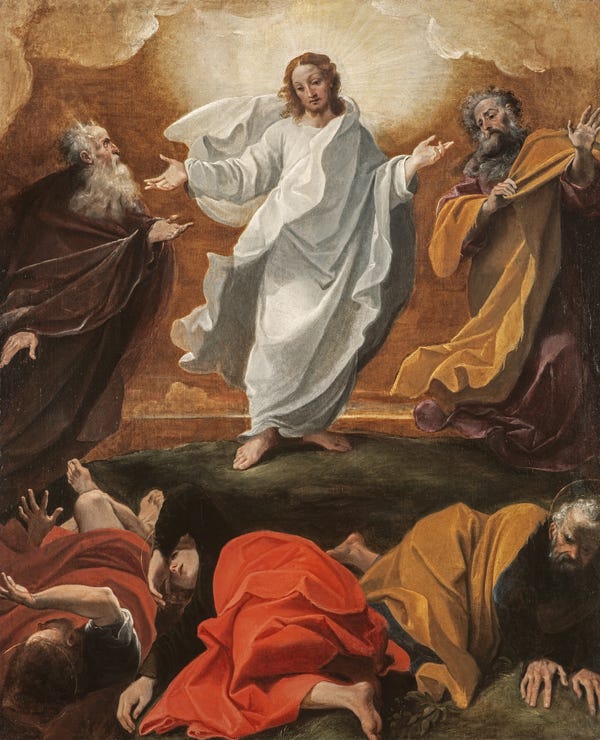
Sixteen hundred years later the Vatican's 1976 declaration Inter Insigniores against ordaining women made the same move. The priest stands in the person of Christ, and sacramental signs work by natural resemblance, so the priest must be a man, because, in the document’s own words, “Christ himself was and remains a man.” Remains. Not was, in the flesh he took in order to redeem it. Remains, forever, world without end.
I don't know what happened to Christ's sexed body in the resurrection. Nobody does. What I notice is that Paul says our lowly bodies will be conformed to his glorious body, and not the other way around, and that Maximus says the humanity we are being remade into is neither male nor female. Put those together and the question answers itself, or at least it starts to. Bryce Rich and Cameron Partridge have both pressed on this and I find them persuasive.7 I am not going to settle it in an essay about something else. I only want you to see what the argument against trans and non-binary people is actually made of. When the church needed Christ's maleness to be eternal, it became eternal. Can't have women asking to serve at the altar.
A foretaste
So what could this mean for trans and non-binary people today? If the male and female division is a mode of fallen existence rather than the truth of what we are, and if it is the first thing Christ heals, and if the human being of the age to come is neither male nor female but simply human, then trans and non-binary people are not living in violation of their nature. They may be living closer to it, at least as a sign of the humanity the resurrection reveals we were always destined for.
What else do we call it when someone experiences a foretaste of the kingdom’s reality in the already/not yet? Usually we think of it as a sacramental healing. No sacrament gives us the fullness. The Eucharist does not end our hunger; it gives us a taste of a table we have not sat down at yet. Baptism does not finish our dying and rising; it plants the kingdom in us as a seed. Every sacrament is the future breaking into the present in a partial, real, insufficient way, a foretaste that makes us long for the meal.
In that case I want to suggest that trans and non-binary lives may be sacramental in exactly this sense. A body that does not resolve neatly into the binary, a person whose life will not sit still inside a division that Christ came to drive out of nature, is not a mistake in the order of creation. That person may be a sign, in the present tense, of the humanity all of us are being remade into. The church has long venerated saints whose stories involve crossing gendered expectations, including figures assigned female at birth who lived in men’s monasteries under male names.8
Of course all sites of grace are gifts, and not merited. Nobody is holier for it, any more than a person healed of an ailment is holier than the one not healed. And it cannot become a job. Trans people do not owe anyone eschatological signification. They need rent and healthcare and to be left alone, and if this idea becomes one more burden laid on their backs, another way of making them useful to a church that has mostly made them suffer, then I would rather not have said it.
But I think if any of part of this faith is true then this must be as well, and I think it is the tradition’s own logic, followed where it goes and unconstrained from the cultural domination of patriarchy.
In the end, you will be known. You will be recognized. And whatever you are becoming, it is not less than what you are.
Gregory of Nyssa, On the Making of Man, chapters 16–17. The argument that the image of God in Genesis 1:27a is unsexed, and that the male/female division of 1:27b is a second moment tied to our mortal condition, is developed there. Scholars debate whether Gregory means the division follows the fall or was provided in foreknowledge of it; the distinction matters less than the point that it is not, for him, what the image consists of.
Maximus the Confessor, Ambiguum 41. English translation by Nicholas Constas, On Difficulties in the Church Fathers: The Ambigua, Dumbarton Oaks Medieval Library (Harvard University Press, 2014). The three passages on male and female appear at PG91 1305C, 1309A, and 1309D.
The figurative reading is argued by Adam G. Cooper, The Body in St Maximus the Confessor: Holy Flesh, Wholly Deified (Oxford, 2005), and Doru Costache, “Living above Gender,” Journal of Early Christian Studies 21, no. 2 (2013). Maximus glosses “neither male nor female” as neither anger nor desire (thymos and epithymia) in his Commentary on the Lord’s Prayer. Against the figurative reading, see Cameron Partridge, “Transfiguring Sexual Difference in Maximus the Confessor” (ThD diss., Harvard Divinity School, 2008); Sotiris Mitralexis, “An Attempt at Clarifying Maximus the Confessor’s Remarks on (the Fate of) Sexual Difference in Ambiguum 41,” Filozofija i Društvo 32, no. 2 (2021): 194–203; Emma Brown Dewhurst, “The Absence of Sexual Difference in the Theology of Maximus the Confessor,” Filozofija i Društvo 32, no. 2 (2021): 204–225; and Dionysios Skliris, “The Ontology of Mode in the Thought of Maximus the Confessor and its Consequences for a Theory of Gender” (2017). Both Filozofija i Društvo articles are open access.
Some conservatives know this. Brian Patrick Mitchell, an Orthodox deacon with a doctorate in theology, published his dissertation as Origen’s Revenge, arguing that Christian thinking about male and female was corrupted early by Greek philosophy that held the body in contempt. The carrier of that corruption, in his telling, is Maximus the Confessor, a saint of Mitchell’s own church. They call him Confessor because the emperor’s men cut out his tongue and severed his right hand, taking the voice and the writing hand of a man who would not stop insisting that Christ was fully human. He confessed anyway, and died of it. Mitchell reads him carefully and gets the reading right: Maximus taught that God will remove the bodily difference between male and female, and that the difference was never part of the divine plan for humanity to begin with. Mitchell’s response is to conclude that Maximus was wrong, that a Confessor of the Church swallowed a heresy and handed it down to the rest of us. He is not defending the Fathers from people like me. He is defending gender essentialism from the Fathers. It is worth knowing what he wanted it for. The same year, he published The Disappearing Deaconess, arguing that the church was right to stop ordaining women deacons, and he describes his theology of male and female as the key to a range of questions including, in his own words, the exclusion of women from clerical orders.
Gregory of Nyssa, On the Soul and the Resurrection, a dialogue Gregory sets at his sister Macrina's deathbed, in which she answers his objections about the resurrection body. The Life of Macrina and this dialogue together present her as his teacher on these questions.
Augustine, City of God, 22.17. He argues that women will rise as women and that sexual difference persists in the resurrection, against those who held that the risen body would be male or sexless. His concern is continuity of the body and the goodness of the created difference, but the practical stake is visible in the argument: if the difference were to be erased, the case for maintaining it now would collapse.
Bryce E. Rich, Gender Essentialism and Orthodoxy: Beyond Male and Female (Fordham University Press, 2023). Rich, an Orthodox theologian, argues from within the tradition against the idea that male and female are ontologically fixed and incommensurate categories, and draws out the implications for women's ordination and for pastoral care of intersex, transgender, and nonbinary people. See also his essay "In persona Christi: The Rise of the Phallogocentric Eucharist."
A cluster of saints assigned female at birth who entered men's monasteries and lived out their lives as men. Assigned Mary, he lived and died as the monk Marinos. Assigned Euphrosyne, he lived as Smaragdos. Assigned Eugenia, he became an abbot as Eugenios. Assigned Matrona of Perge, he entered a men's monastery as the eunuch Babylas. Most were discovered only at death. The church venerated them, gave them feast days, and put them in its liturgical books, all while a canon from the Council of Gangra (340) formally prohibited what they had done, and while continuing to list them on its calendars under the names they were given at birth rather than the ones they lived under. Several of these Lives are probably legendary, and the scholarship on how to read them is contested. See Roland Betancourt, Byzantine Intersectionality (Princeton, 2020), and Alicia Spencer-Hall and Blake Gutt, eds., Trans and Genderqueer Subjects in Medieval Hagiography (Amsterdam, 2021).
Thank you so much for this! As a trans Christian I've really been struggling with what to think of the body; a low view felt wrong because I really do care, but a high view felt wrong because I have so many problems with it. I know why they do it but it's a pet peeve of mine whenever people are defending trans people they basically treat gender as pointless and I'm really glad you didn't do that. The idea that sex passes away and the identity remains is honestly one of the most beautiful things I've heard; trying not to cry in the middle of a data structures class I'm ignoring to read this
Love this Colten