
Caught Between the Prophetic and the Pathetic
What a Century of Black Radical Thought Teaches Us About Lesser-Evil Voting

***Disclaimer: I recognize that at first these reflections might come across as an argument not to vote. So I want to be clear about what I am not arguing. I voted for Kamala Harris in 2024 and I might vote Democrat again. Adolph Reed Jr., whose critique of the Democratic Party is about as sharp as anyone’s, held his nose and voted against Trump in 2016 and wrote honestly about why in his article “Vote for the Lying Neoliberal Warmonger: It’s Important.” The question I am raising is not what you do on election day. It is about what we do every other day, and whether the conversation we are having right now is building anything that lasts.
Dr. Umar Johnson is a man who, for better or for worse, is full of hot takes. Some are genuinely sharp. Many are homophobic, misogynist, and just flat wrong. But we both grew up running the same streets of North Philly, and so I find him relatable in a very specific kind of way. Kinda like a loud problematic uncle. So when I saw a video of pollster and political commentator Joshua Doss (a guy I generally like and respect), reacting to a clip of Dr. Umar declaring he did not vote for Kamala Harris, it caught my attention. And I have some thoughts.
Doss, who says he’s not a democrat or a leftist (which puzzles me), reacted with a lesser of two evils argument that has more meat on its bones than I normally come across. He broke down a concept his economics professor taught him called BATNA or Best Alternative to a Negotiated Agreement. He illustrates it with a scenario: a green guy and an orange guy are locked in a room with a million dollars and one hour to split it. If they reach a deal, they both walk out with money. If they don’t, they get nothing. The green guy proposes 50/50. The orange guy demands 600K or no deal. They argue, the clock runs out, the green guy walks out broke but morally satisfied. What he didn’t know is that the orange guy was operating under different rules. He was secretly given different parameters. If no deal was reached, he still walked out with 500K. The green guy’s principled stand cost him everything and his opponent nothing.
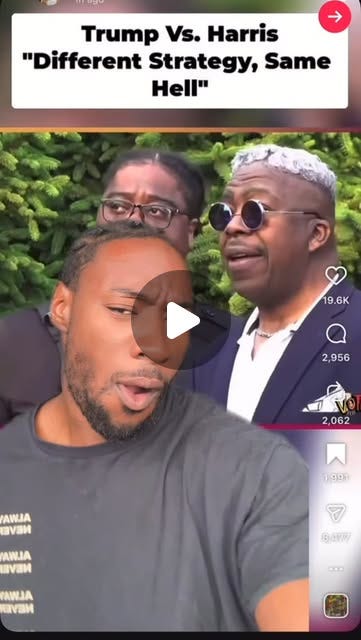
Doss applies this logic to politics by arguing that a deal only makes sense if it’s better than your no-deal option. What Black people got with the no-deal option in 2024 was Trump. Refusing to vote for Harris didn’t hurt the orange guy. It just left the green guy broke.
It’s a genuinely sharp argument. But it has a hidden premise doing a lot of unacknowledged work. It assumes the relevant negotiation is always and only between the two candidates currently on the ballot. Change that premise and the whole calculation inverts.
The problem is that Joshua is doing single-round math in a multi-round game.
I actually learned about BATNA from my wife during her law school years. I spent a lot of time helping her prepare for mock negotiations, and something she taught me is that you have to be careful when considering your opponent’s BATNA because the calculus changes completely when there are multiple rounds of negotiation. What looks like the right choice in round one can set you up to lose everything by round five. Accepting a bad deal trains the other party to keep offering bad deals. It signals that bad deals are acceptable. The floor you accept becomes the ceiling you negotiate from next time.
Before we go further I want to acknowledge that I am a white guy critiquing an argument from a black man about how black people should vote. However, I am neither offering a perspective that I personally developed, nor did this conversation start with Joshua Doss and Dr. Umar. In fact, black activists and intellectuals have been working through this exact question for over a century. I’m not introducing a new argument; instead, I’m trying to amplify one made by people like Ida B. Wells, Malcolm X, Amiri Baraka, and contemporary scholars like Adolph Reed Jr. and Cedric Johnson, an argument that has been deliberately crowded out.
What do the prophets say?
The prophets of the Old Testament were not fortune tellers. They were social critics, appointed to see clearly when the dominant imagination had captured everyone else, to name the idols of their age, and to tell the truth about power regardless of the cost. The work of the prophet is about clarity not prediction. And the Black prophetic tradition is the most sustained and rigorous exercise of that function in American history. The people I named above, alongside figures like James Cone, Cornel West, W.E.B. Du Bois, and Angela Davis were not simply political thinkers. They were people who could see the idols clearly because they had never been invited to worship them, and they named the ruling powers for what they were at enormous personal cost.
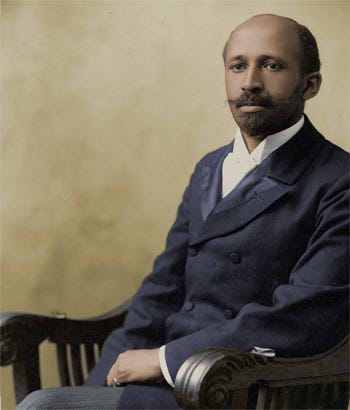
W.E.B. Du Bois spent 67 years experimenting with the lesser-evil logic Joshua describes. He voted Democrat for Woodrow Wilson in 1912 after the Republican convention refused to adopt a racial equality platform he had written himself, then watched Wilson impose Jim Crow on the federal civil service within months. He cycled through Democrats, Republicans, Progressives, and Socialists across four decades, documenting each betrayal in real time. His assessment of his 1916 vote for Republican Charles Evans Hughes was that he was “the lesser of two evils. He promised Negroes nothing and kept his word.”
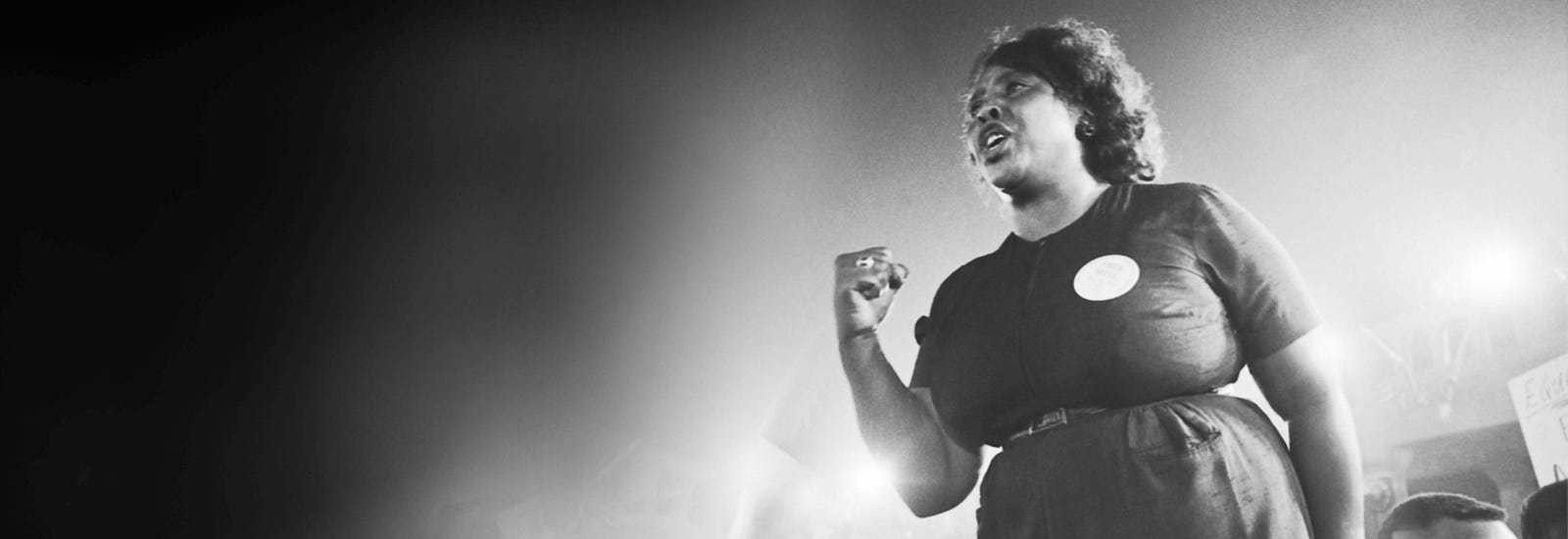
Fannie Lou Hamer actually tested the Democratic Party's limits. She brought a legitimate integrated delegation to the 1964 Democratic National Convention, followed every rule, and testified before the Credentials Committee with such force that Lyndon Johnson called an impromptu press conference specifically to knock her off the air. It backfired. Networks rebroadcast her testimony in full during prime time. The compromise the party offered her was two pre-selected at-large seats while the segregationist delegation kept theirs. Her conclusion cut to the bone: the party would take whatever you gave it and return as little as it could get away with. "If the white man gives you anything," she said, "just remember when he gets ready he will take it right back. We have to take for ourselves." And even though Hamer never formally left the party, returning to the Democratic National Convention as an official delegate in 1968 and again in 1972, she concluded that the Democratic Party would not voluntarily deliver. The party had to be forced, not trusted, and the organizing required to force it was more important than the vote itself.
This is exactly what political scientist and cultural critic Adolph Reed Jr. has been arguing about Black electoral politics for decades. Reed’s critique is not that voting is useless. It’s that unconditional loyalty to a party, surrendered in advance, is the negation of political power rather than its exercise. Every cycle in which the Democratic Party extracts maximum turnout from Black voters (or voters from any marginalized group for that matter) by pointing at the Republican threat, then governs from center-right once in office, is a cycle in which the party learns it doesn’t have to deliver anything. The threat has to stay credible. The BATNA has to stay terrible. That’s the strategy the ruling class uses to systematically disenfranchise the working class. This is one of the reasons I believe that Democrats have failed to enshrine advances made through the courts into law despite having the chance multiple times. They need things like abortion and gay marriage to remain fungible enough to continue to use as a cudgel for reluctant voters.
This leads to a sort of ratchet effect where the election of a democrat theoretically stops things from moving right, but it does not move them left in a meaningful way. Meanwhile, the Trumps and their ilk don’t stay the same. They get more dangerous. Each cycle of lesser-evil voting produces a Democratic Party that has moved further right, which normalizes a new center and gives the Republican opposition room to move even further right. Trump in 2016 was treated as an aberration. By 2024, he was the template. The next version won’t need to pretend to be anything other than what he is. Joshua’s logic, applied faithfully across enough cycles, doesn’t protect you from fascism. It walks you toward it one concession at a time.
Reed would say that the problem isn’t voting. It’s the substitution of voting for every other form of political power. Organizing, coalition building, withholding support to extract concessions, building independent institutions: none of these appear anywhere in Joshua’s framework. The only tool in his toolbox is the ballot, deployed every four years against the worst available option. In practice this looks less like negotiation and more like a hostage situation where the hostage keeps paying the ransom and wondering why they never get released.
Thinking outside the negotiation room
Joshua’s critique of Dr. Umar’s position then pivots rather abruptly to the follies of the white leftist failson. He admonishes the viewer to consider the source. He says, when you hear someone with a trust fund and a Brooklyn zip code telling you to never vote blue no matter who, ask yourself whether the consequences of that advice land on them the way they land on you. Are they living under the shield of their daddy’s spare loft in Williamsburg? That’s a fair point. But the same logic, applied more honestly, dismantles his own argument.
My admonition, dear reader, is when you hear an American liberal telling you that you have to vote blue no matter who, ask yourself whether they are speaking to you from under the shield of the most powerful military empire in human history. Ask whether this president’s policies will affect them the way they affect the families in Yemen being bombed with American weapons, the children in Gaza being starved with American support, the people in Haiti destabilized by decades of American intervention, the millions across Latin America and Africa living under the economic boot of IMF structural adjustment programs designed in Washington. A 2025 study published in The Lancet found that US and European unilateral sanctions kill approximately 564,000 people per year. That’s 38 million people between 1971 and 2021. More than half of them children. Both parties have prosecuted that project without serious interruption.
Joshua’s framework has no account for any of this. His BATNA calculation begins and ends at the American border. The green guy and the orange guy are locked in a room, and the people dying outside it don’t get a seat at the table.
None of this is an argument for staying home. What I am arguing is that if the only political conversation we are having this far from an election is an unnuanced "take what you can get and be grateful," we are already losing. Reed's point, and Hamer's, and Du Bois's, was never that the ballot is worthless. It was that a ballot without organizing behind it, without the credible threat of withheld support, without independent institutions and coalitions that exist and fight between elections, is a ballot that purchases nothing.
The Democratic Party has learned it can take Black voters, working class voters, and every marginalized community for granted because the threat never materializes. Every four years the emergency is declared, the lesser evil is endorsed, and the organizing dissolves back into electoral energy that the party absorbs and neutralizes. The question is not whether to vote. The question is what we are building when we are not voting, and whether we are ever going to make them earn it.
Heeding the prophets
Our world is ruled by ghouls and goblins. We all agree on that. How so many are still persuaded that their rule is better than any possible alternative is the outcome of a deep and practical sort of magic wrought on our imaginations, trapping and squeezing them, shackled in a prison called capitalism. They murder and starve children around the world with impunity. They force the elders of society into lives of destitution and institutionalize them into subservience. They enslave our young people into the bondage of debt where not even bankruptcy can save them. They let us argue over scraps, over the lesser of evils. “Let them debate which one of us will do them less harm” they say to each other, “And let us give to some a bribe of meager privilege that they might wage war on each other and never notice us.”
They serve a pantheon that consists of Avarice, Death and Erebus. And our minds are lost to them. I’m sick and fucking tired of it. Exhausted. We all are, but this is not a game of theory. There are real children dying. Real stakes. Real lives being traded so that a handful can destroy themselves through gluttony. We must wake up from our delusion, refuse the game, ignore their rules, despise their boundaries and limitations. A prophet named Du Bois once told us that “Capitalism cannot reform itself; it is doomed to self-destruction.” And as long as we do not throw off its shackles, it will be a mutual self-destruction. An abomination of desolation.
American Democracy has always been a lie. As Fannie Lou Hamer said, it has always been “With the handful. For a handful. By a handful.” But history has not ended, only our imaginations have been deprived. And while it might be easier to imagine the end of the world than the end of capitalism, the truth is that the world will indeed persist far beyond this nihilistic age. We have to condition our minds to challenge the dominant framing, take off the bumper rails. There is a whole world of possibility out there beyond our invisible fence. But first we have to name that fence for what it is, take off our collars, and refuse to see it as a permanent boundary. In America that begins with recognizing the corpse in our midst.
“There is but one evil party with two names, and it will be elected despite all I can do or say. Stop yelling about a democracy we do not have. Democracy is dead in the United States. Yet there is still nothing to replace real democracy. Drop the chains, then, that bind our brains. Drive the money-changers from the seats of the Cabinet and the halls of Congress. Call back some faint spirit of Jefferson and Lincoln, and when again we can hold a fair election on real issues, let’s vote, and not till then. Is this impossible? Then democracy in America is impossible.”
A challenging read. Thanks for the wonderful historical framework.
Colten, I normally like your content, but I really did not like this draft. Why even mention Joshua Doss’s video and then knock it for not making points that it was not designed to make. You wrote a fine article about the lesser of two evils, the importance of civic engagement beyond just voting, and the importance not letting people take us for granted. In your next draft, leave it at that without referring to Doss. When Doss says there were people who didn’t love Kamala, he is not making a lesser of two evils argument. Enough people did love Obama and he won twice, but people don’t have to love candidates to still have a reason to vote for them. The problem was that love is what people were looking for, love for the candidate and for every policy, and if not, no vote. He was also making a point that we often assume that everyone else is in the same boat as us and will be affected in the same way, but that is not reality. These are very good and important points.
Doss’s story about the million dollars and the green and orange guys was insightful. Green guy assumed orange guy was operating from the same rules and wanted more or nothing. For the orange guy, we have to ask, was he aware that his holding out for the additional 100k was going to cause the green guy to leave with nothing? Did he know and not care or did he assume that the their rules were the same? Would he really settle for the outcome where he gets 500k and his opponent gets nothing rather than the scenario where they both leave with 500k? Why? Doesn’t he know that he is less safe when they both leave the building because people have killed others for a lot less. But the green guy will likely not resort to violence because he believes he is morally superior, even though we know that belief is misplaced. He is a fool because he still could’ve had 400k. We should let this sink in.
The points you make are also good. But wisdom is not a zero sum game. What you say can be true and helpful without forcing Doss to be wrong or not going far enough.