
Biting Into Life (Redux)
The Politics of Existential Freedom Or Why I Started a Substack
Thanks for reading Kensington Koan. If you like what you read, or hate it enough to want to keep tabs on me, please consider subscribing to get my new posts sent directly to you. They are all free for the first 6 weeks. After that the full archive is available to paid subscribers. If you became a paid subscriber, it would really help me to keep producing this work. If you really want access and $8 a month is just too much right now (trust me I’ve been there most of my adult life), send me a direct message and we will work something out. <3
If you want to check out any of the books I recommend in my content, consider purchasing them through my Bookshop.org store instead of Amazon. You can choose a local bookstore to support with your purchase and help support my content as well.
https://bookshop.org/shop/coltenbarnaby
Quick note: It has been an exceedingly busy and fruitful week. Which means despite making progress on the article I wanted to post this week I found myself unable to get it up to the standards I normally hold myself to. I hope you will extend your grace to me for not delivering on my normal weekly rhythm. So this week I am posting an article I published in March of 2025 when I had 25 subscribers. It is likely the vast majority of you have not read it. This post is a reflection on what lead me to start this Substack, which also lead me to start posting video content on social media in July of 2025. You can find me on instagram here.
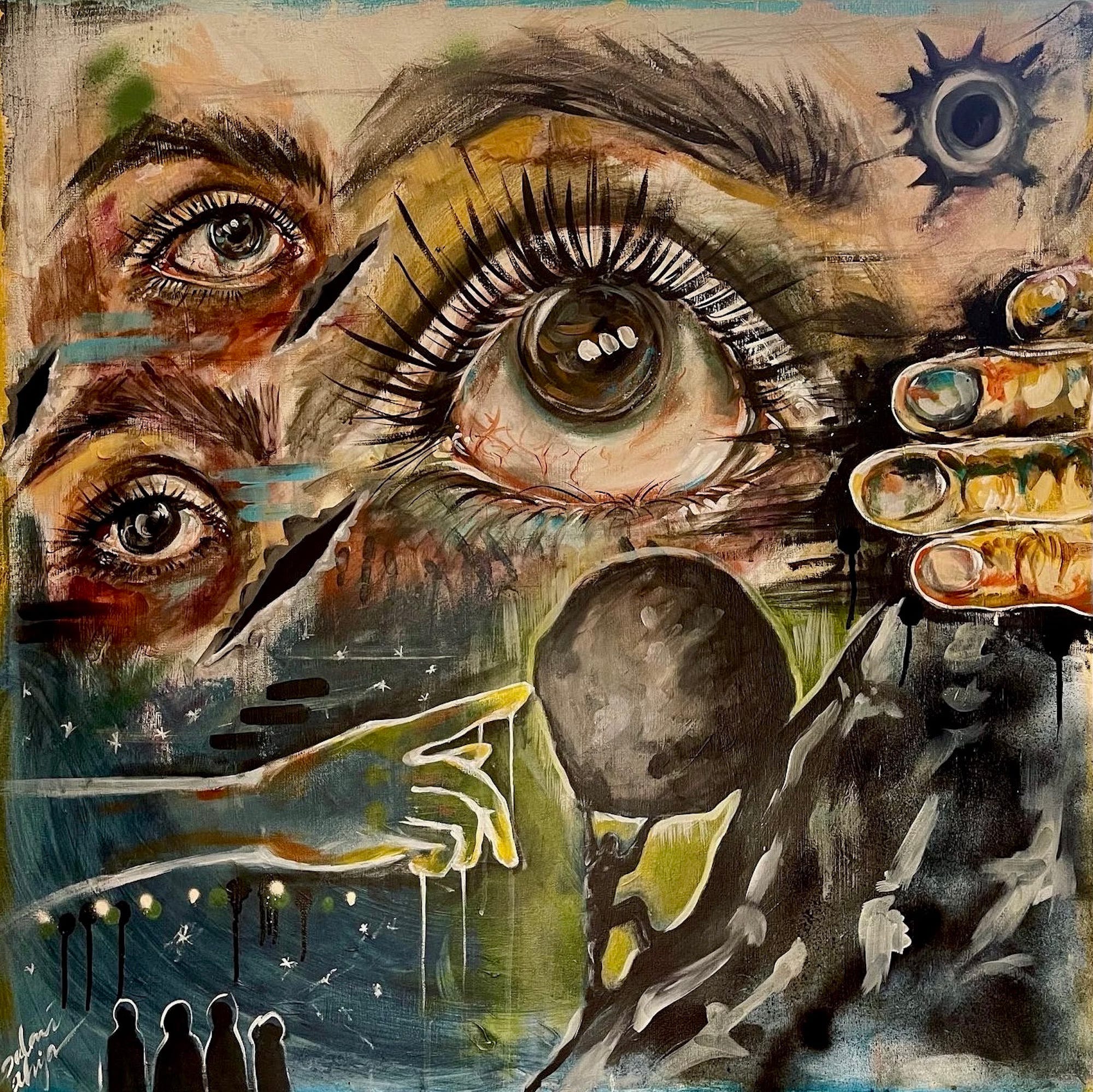
It was nearly midnight, and I sat motionless at my desk, eyes fixed blankly on my screen, confronted again by the same relentless thought: I've spent more than a decade waiting. For what exactly? I’d been waiting to achieve some nebulous standard of financial security, intellectual credibility, or worthiness… an imagined threshold after which my voice might finally matter. But that night, I finally glimpsed the truth: the perfect moment never arrives. You have to act anyway, inside the moments you have, however imperfect they may be.
Earlier that day, my therapist had recommended Albert Camus’s "The Myth of Sisyphus." I took his advice and quickly found myself shaken awake by Camus’s sharp clarity. He writes about the absurd condition of human existence: our endless quest for meaning within an indifferent and silent universe. According to Camus, real freedom arises not by escaping life's absurdity through illusions or despair but by passionately embracing it, rebelling by making meaning anyway.
In the Greek myth, Sisyphus is eternally condemned to push a boulder uphill, only to see it roll back down, endlessly repeating the cycle. Yet Camus insists we must "imagine Sisyphus happy." His happiness lies precisely in his conscious rebellion, his acceptance of futility without hope of divine intervention. Sisyphus becomes free because he creates meaning in the very act of his endless struggle. Camus admonishes us, do not attempt to escape the absurd, confront it.
Jean-Paul Sartre vividly illustrates the stakes of Camus’s warning in The Age of Reason, portraying the existential consequences of a life spent waiting
“I have led a toothless life,” he thought. “A toothless life. I have never bitten into anything. I was waiting. I was reserving myself for later on and I have just noticed that my teeth have gone. What’s to be done?…”
“A life,” Sartre writes, “is formed from the future just like the bodies are compounded from the void.” Mathieu, the protagonist, bends his head in remorse, realizing with devastating clarity that his present self, “weary and a little over-ripe,” was precisely the future his younger self once hopefully anticipated. The youthful promises, “I will be free,” “I will be famous”, now haunted him, their insistence cutting sharply across the years. He is, at times, “visited by attacks of devastating remorse”, as the full weight of his inaction collapses in on him, exposing how thoroughly he had betrayed his own vision of the future.
These lines pierced me. Sartre captures the bitter truth of existential procrastination, the dull ache of recognizing your current self as the disappointing future your younger self unwittingly created by perpetually deferring authentic living. Langston Hughes evokes a similar existential pain in "Harlem":
"What happens to a dream deferred? Does it dry up like a raisin in the sun?... Or does it explode?"
For years, I’d quietly felt this despair. Growing up within evangelical Christianity, my early life was steeped in a promise of escape from absurdity through divine intervention, the Rapture, deliverance from earthly despair. When that spiritual hope faded, I replaced it with something more grounded, more socially acceptable: the pursuit of financial independence. It felt responsible, even virtuous, a way to secure my future, to buy back time, to live on my own terms. And there's nothing wrong with building security. But in hindsight, I can see that it wasn’t freedom I was chasing, but another form of escape. I wasn’t confronting absurdity or the material struggle of life; I was trying to outmaneuver them.
When that too failed to deliver the clarity or meaning I was grasping for, suicidal ideation became a twisted replacement, an imagined escape from the crushing absurdity of existence. I didn't truly desire death, but I envied its imagined freedom from the struggle.
This dark recognition surfaced clearly for the first time when a close friend took his own life. Amid collective grief, I felt a terrifying envy, a twisted jealousy toward the finality of his escape. It disturbed and frightened me, but it was undeniably real.
The brutal honesty of Camus and Sartre offered me a lifeline out of that quiet despair. Not by restoring false hope, but by extinguishing it altogether. Proverbs 13:12 says plainly, "Hope deferred makes the heart sick." I now realize that my heart was sickened not just by disappointment, but by the very act of passive hoping itself. I had become trapped waiting for external salvation, a financial windfall, societal validation, or some divine rescue…before I let myself actually live.
This Substack is a part of my rebellion. It's my conscious rejection of passive hope and existential procrastination. It's me biting decisively into life, despite the absurdity. But existential freedom isn't personal alone. Today, those who relentlessly accumulate wealth and power wield agency without ethical constraint. Meanwhile, those of us who actually care about justice or solidarity keep hesitating, keep waiting to be invited, keep waiting for the moment to feel right.
Perhaps our hesitation is precisely why the world tilts toward exploitation rather than solidarity.
The odds are stacked against justice, truth, and equality. Our revolts, personal or collective, offer no guarantee of victory. But maybe existential rebellion isn’t about success. Maybe it’s about acting authentically, passionately, even desperately, precisely because no promise of victory exists, and because waiting passively ensures defeat.
And maybe, in order to face the enormity of that struggle, without illusions, without guarantees, we first have to confront the absurd in ourselves. Perhaps the courage to fight for material freedom, for collective liberation, can only emerge from the kind of existential freedom Camus describes: the refusal to look away, to wait, to hope for rescue. The refusal to live anyone else’s meaning but your own.1
I cannot experience your freedom, only my own. But I can tell you this: the alternative to existential revolt, a life lived waiting for permission, is unbearable. So here I am, doing my best to reject false hope, embrace absurdity, and choose authenticity, knowing fully there are no guarantees.
Extending personal revolt into political revolt is something Camus and Sartre famously broke over. In 1951 Camus published The Rebel, arguing that rebellion carries built-in ethical limits, and that the leap from “I refuse” to “we will remake history” tends to collapse into ideology and a new tyranny replacing the old. Sartre’s circle answered with a long, public demolition. They accused Camus of moralism and political cowardice. Camus accused Sartre of laundering Soviet atrocities through philosophy. The friendship never recovered and Camus died in a car crash eight years later.
I’m pulling from both of them anyway, knowing they didn’t agree. From Camus, the refusal of passive hope and the demand to face the absurd without illusion. From Sartre, the claim that failing to engage politically is itself a choice and the future you live in is the one you’re building right now by not acting.
“No valid plans for the future can be made by those who have no capacity for living now.” - Alan Watts
This piece really reminded me of that line. Especially the movement from waiting for permission or certainty into actually choosing to live and act despite the absence of guarantees.
Really enjoy your writing, Colten. Helps me better understand myself by bringing what drives me into words. I've never concretely said leaving Christianity was me refusing to escape, but rather I saw it as a desire to participate with reality as it presented itself to me, and not as it was taught to me. And funny enough, seeking financial security came into my life shortly after leaving the faith. Interesting to see it as a way of moving from one 'escape' to another. Makes me question what areas of my life are still my way of seeking escape. Either way, thank you again. Your words take up space in my brain, and in particular I don't think I'll ever get over, "Am I a better father than God? I still haven't found a reason to say no."